
BRIEF
The company is an EdTech startup which goal is to create a social app similar to Tiktok that would help students prepare for exams. The app consists in scrolling through educational videos and make students unlock "Capsules" that consist in videos and quizzes focusing on specific subjects.
The brief I was given was the following:
"Adding social (gamification) to capsules: You are the designer of the “Capsule x Social” crew. We have the data of all capsules done and scores obtained of a user friends. Our goal is to boost these capsules usage through social competition and recommendation. Can you design components to reach these goals? Please limite yourself to capsules for now and limit time spent on the case-study to 2 to 3 hours."
IDEATIONS
Given the restricted time limit of this case study and my knowledge in gamification mechanics, I decided to first explore straightforward types of social gamification that I condensed in a "privacy" VS "action" graphic.
"Privacy" means that the user knows who they are playing against, while "action" means that the player is actively competing against others and allocate specific time for this competition.

Teenagers hold great importance to relationships with their friends (eliminating the Global leaderboard idea), and a quick Google search provided my with multliple studies showing that 1v1 features such as Flame Streaks on SnapChat or TikTok took a large place in this audience's relationships. I therefore concluded that the more personal and active the feature was -allowing to purposely maintain the in-app relationship with individual friends- the more likely students would be to use it.
My choice finally went towards the 1v1 Mini-Game gamification type, using the quizz feature.
USER FLOW
Once I defined my idea, I went into creating a user flow for this feature. Greyed out sections are those in which player doesn't take action.

Prototype
To use both 1v1 Mini-game format and the quizz feature, I decided to design a 1v1 quizz mini-game based on famous similar games like Dual Quizz.
The prototype I made simulates the user taking turn in 2 different quizzes with 2 different friends (both friends already played their turn and are waiting for user to playe theirs).
I could therefore create a high-fidelity mockup of the user flow defined earlier on Figma.
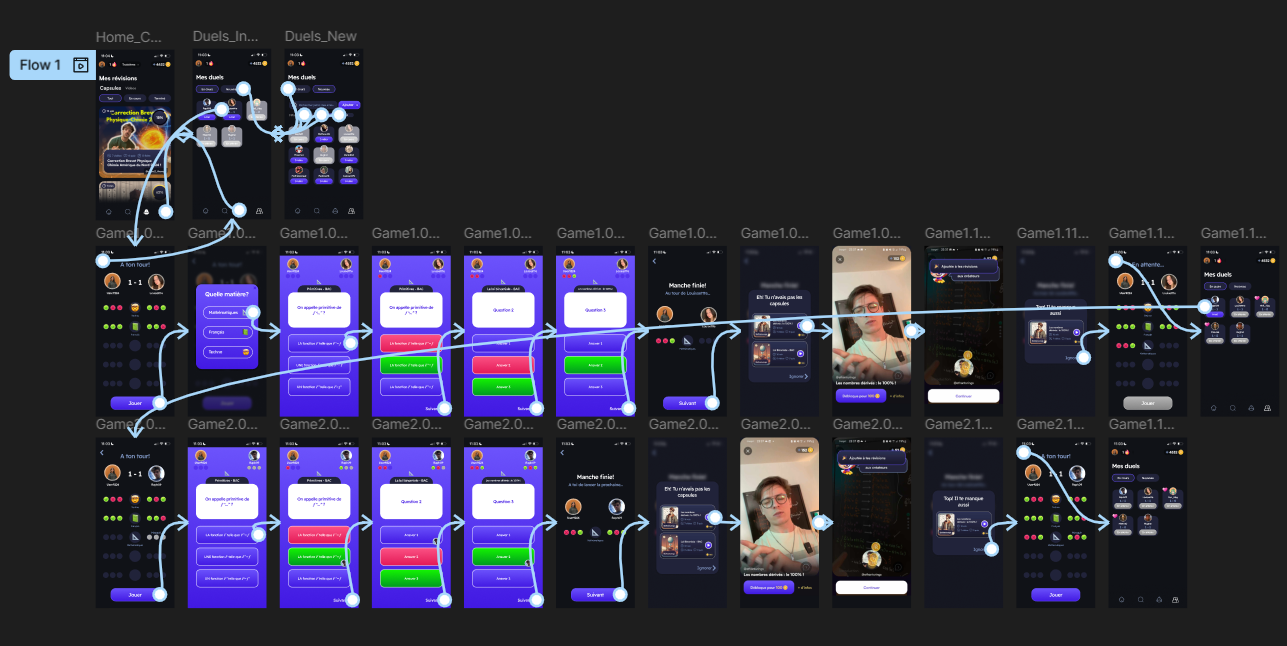
You can find below the interactible figma mock-up: